

Home / Insights / Thought Leadership
The Evolution of Venue Design
For decades, stadiums and arenas had a straightforward purpose. They hosted games for a home team, welcomed fans on game day, and sat relatively quiet between events.
Now, large-scale venues are expected to do much more. Today’s venues might host an NBA game one night, an NHL game the next, a major concert over the weekend, and an international sporting event shortly after. Convention centers, mixed-use entertainment districts, and sports complexes face similar demands as they compete to attract events, visitors, and revenue year-round.
While the goal of getting fans into seats hasn’t changed, success no longer depends solely on attendance during a single season. It depends on how often a venue can activate its spaces, how quickly it can transition between events, and how consistently it delivers an exceptional experience for fans, athletes, performers, broadcasters, and operators. That shift has transformed the way we engineer venues.
From game day to every day
When Henderson Engineers entered the venue sector more than 30 years ago, sports and entertainment facilities looked very different than they do today. Our experience designing retail environments taught us an important lesson that continues to shape our work: people remember experiences.
As we expanded into recreation, convention centers, collegiate athletics, and professional sports, we saw those expectations grow. Venues no longer compete with the team across town for audiences. They compete with every entertainment option available to fans.
Owners expect their facilities to generate activity throughout the year. Professional sports still anchor the calendar, but concerts, conventions, international competitions, esports, community events, and even weddings have become equally important to the success of a venue. Every additional event creates an opportunity to increase revenue, strengthen community engagement, and maximize the long-term value of the facility. Meaning flexibility is more than a design goal; it’s a business strategy.
Every building system plays a role
The most successful venues do not rely on temporary solutions every time the schedule changes. Instead, we design adaptability into the infrastructure from the beginning. Take an arena that hosts both NBA and NHL games as an example. Each league requires its own lighting standards to support athletes, officials, broadcasters, and fans. Engineers often design lighting and audio systems so operators can transition between seasons without sacrificing performance or broadcast quality. At Henderson, many of our engineers sit on committees that help set those standards or consult with ownership groups to see where venues are meeting, exceeding or falling short of standards.
The same philosophy extends to other building systems. When operators remove permanent seating to accommodate a larger playing field for international soccer competitions, mechanical, electrical, plumbing, telecommunications, security, and life safety systems all need to support those rapid transitions without disrupting operations.
Playing surfaces have evolved, too. Heated and cooled field systems help maintain consistent conditions throughout the year, while venues continue to adapt to changing preferences for natural grass and synthetic turf. We typically design for the worst case (most people during the hottest day) and then the systems modulate or reduce outputs for heating/cooling as needed based on the event and number of people/temperatures.
Every decision contributes to one outcome: helping owners move from one event to the next as efficiently as possible.
Lighting has become part of the show
Venue lighting is a great example of how standards have changed dramatically over the past decade. Lighting no longer only serves the athletes on the field but helps to shape the fan experience. Today’s lighting systems support broadcast requirements, create immersive player introductions, synchronize with audio and video systems, and transform venues for concerts and entertainment events.
We’re now able to design lighting systems that support dynamic player introductions with follow spots while integrating with concert and entertainment programming. Permanent entertainment lighting gives operators greater flexibility, reduces the need for temporary production equipment, and improves safety by minimizing overhead installations during event conversions. The result is a better experience for everyone involved, from performers and production crews to fans in the stands.
Great venues continue to evolve
Not every venue project begins with a blank sheet of paper. Many of today’s most valuable investments focus on extending the life of existing facilities while preparing them for the next generation of events.
Our work at MetLife Stadium demonstrates how thoughtful engineering can help owners accomplish exactly that. Improvements made to premium spaces, telecommunications infrastructure, concessions, and fan amenities help position the venue to continue hosting world-class sporting events while enhancing the guest experience and supporting evolving operational needs.
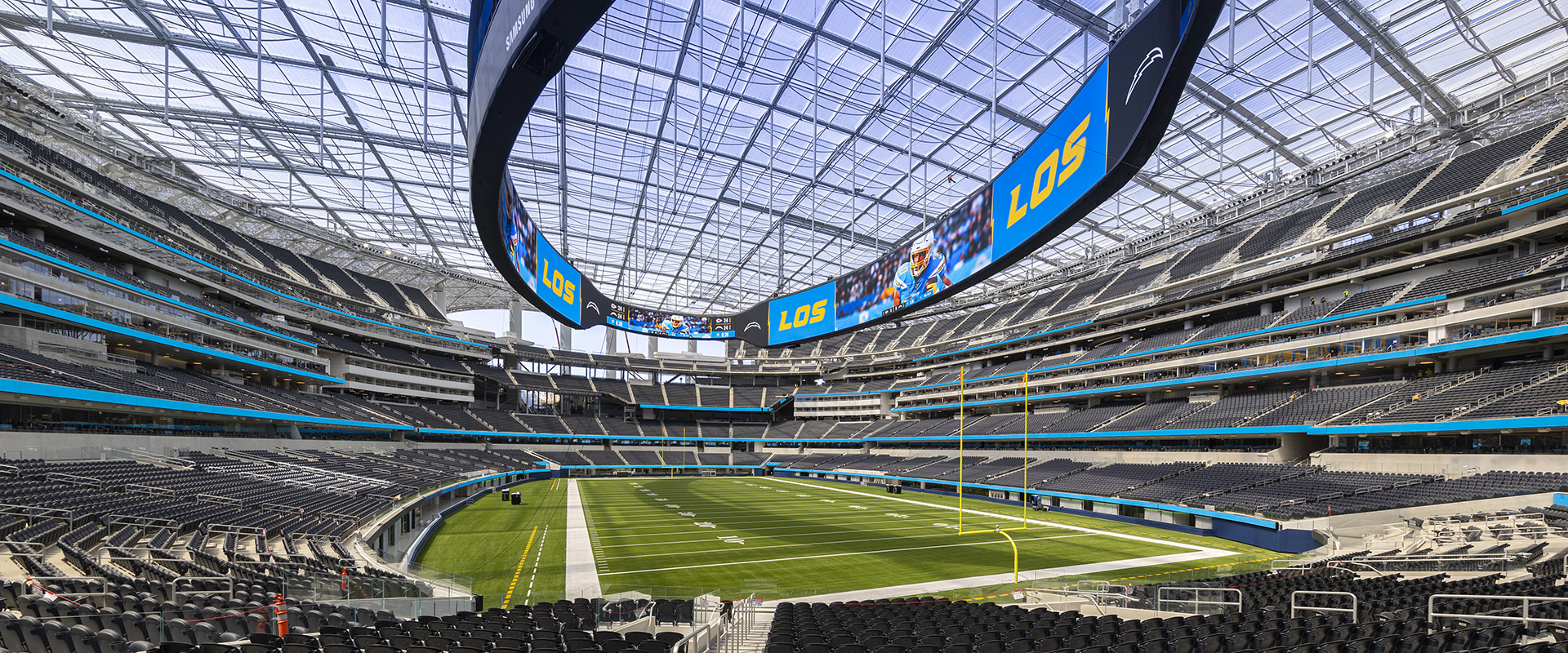
The same philosophy guided our work at SoFi Stadium. From the beginning, the vision extended far beyond creating a home for professional football. The seven-year design process focused on building a destination capable of hosting major sporting events, concerts, and large-scale entertainment while creating memorable experiences for every guest. Every building system supports that flexibility, allowing the venue to adapt as technology, entertainment, and fan expectations continue to evolve. Because of these design choices, we no longer think of SoFi Stadium as just the home of the Los Angeles Rams and the Los Angeles Chargers but as the host of FIFA World Cup games, an Eras Tour host, and so much more.
That same long-term thinking continues to shape projects like the Los Angeles Convention Center renovation. For this project, we’re helping this classic building prepare for the 2028 Olympic and Paralympic Games through a series of thoughtful renovations and upgrades. By providing comprehensive building design services, we’re helping the convention center operate more efficiently while supporting long-term resilience and sustainability.
Our team is advancing campuswide energy strategies through energy modeling, central plant optimization, solar photovoltaic expansion analysis, building envelope performance studies, code consulting, and LEED® compliance evaluations. One of the project’s most significant improvements is the replacement of two aging utility plants with a new campuswide central plant featuring heat recovery and heat pump chiller technology. These upgrades support the facility’s decarbonization and electrification goals while creating more reliable, adaptable building systems that can serve millions of visitors for decades to come. Renovating an active convention center requires more than technical expertise. It demands careful flexibility, operational efficiency, and resilience to help prepare one of the nation’s premier event destinations for decades of future growth.
Sustainability is shaping the next generation of venues
As venue expectations continue to evolve, sustainability is another measure of success. Owners want facilities that reduce operating costs, improve environmental performance, and push the boundaries of what is possible without sacrificing flexibility.
The Intuit Dome represents that next generation of venue design. As one of our industry’s most ambitious all-electric arenas, the project incorporates an off-site modular central utility plant, heat recovery systems, recycled water infrastructure, and under-seat ventilation that delivers conditioned air more efficiently than traditional approaches. Together, those systems reduce energy consumption, improve indoor environmental quality, and support the arena’s climate-positive goals.
The project reflects an important shift across the industry. Sustainability and adaptability no longer compete with one another. The most resilient venues can accomplish both.
Engineering the future of entertainment
The next generation of venues will not succeed simply because they are larger or newer. They will succeed because of their ability to evolve. Owners need facilities that accommodate changing technologies, support new entertainment formats, improve operational efficiency, and set new standards for the fan experience.
At Henderson, we’ve spent decades helping venues evolve alongside the industries they serve. Whether we’re modernizing an iconic stadium, designing a convention center expansion, or engineering one of the world’s most advanced entertainment destinations, our focus remains the same. We create resilient facilities that help owners maximize every event, strengthen long-term operations, and stay ready for whatever comes next.

Recent Insights
Smarter Facility Utilities: Planning for Today and Tomorrow
Today’s industrial facilities rely on increasingly sophisticated technology and utility infrastructure to keep operations moving. Process equipment, robotics, data networks,…
Can You Solve the Net Zero Carbon Rubik’s Cube?
Net zero carbon is the point where global warming stops accelerating. The longer it takes to reach net zero, the…